Monthly Archives: October 2017

Garvey

At first as I was reading our selection of Garvey, I was optimistic that he would do better than Booker T Washington or WEB DuBois in articulating on behalf of black people. Instead, I think he changed the game a bit. While one side previously called to just let African Americans live with their conditions, pack up their marbles and go home, and the other called to try to change things, Garvey seems to combine these two. Instead of just packing up and going home, they’re packing up, going home, and setting up shop there. I don’t know that he had the right idea, but I thought it was a cool one.

Religious Ties

As I was reading chapter 39 of Sernett’s African American Religious History, I made some real life connections that I still observe today. The main point that the letters between the two sisters prove is that African Americans remained loyal to their denominations as they migrated north of the United States. Despite constant enticement from northern churches, many black migrants wouldn’t be members of a church if it didn’t follow the core values that were exemplified in their previous church. In today’s era, there are still many instances of that. When my grandmother moved to Chesapeake, Virginia in her younger years, she participated in local services held in her neighbor’s home before she found a church that was right for her, just like many migrants did in years past.


The link below provides extensive information on the religious diffusion as the Great Migration took place:

http://www.inmotionaame.org/print.cfm;jsessionid=f8301870541509384034151?migration=8&bhcp=1


Compromise

Booker T Washington’s Atlanta Compromise speech is one that can definitely be read as degrading, and I will not disagree with that. Though even with the considered, I can understand the pragmatism of such a speech. It is a speech, as the title implies, that is steeped in compromise. He references the slave labour that black American were forced to do on the farm, but rather than drawing attention to the injustice and oppression of this situation, he focuses on how dilligent and hard working the slaves had been. Washington is working within a system where he believes in order to progress and gain power as a race, they do have to appease those who are currently within power, that being the white oppressor. It is one that continues the idea of black American as subservient to whites, but is within a context where Washington seems to believe that is the best option.

10/31- Dear Mary:–

Though it was relatively short, the chapter which stood out to me most was that of Chapter 39- wherein two “sisters”, whether blood-related or religiously bound, write to each other, one having just moved North as part of the Great Migration. There are several points integral to understanding this document: the first being the already widening gap between the two-in the way that the sisters write (the writing of the Northern sister being more grammatically correct and with less spelling errors), the second being the measures put in place to recruit migrating black Americans to churches (the Northern sister having arrived “in time to attend one of the greatest revivals in the history of [her] life– over 500 people joined the church” (Sernett 366).), and the third being the ways in which the formerly tight-knit community is able to keep in contact after so many moves (repeated requests for the Southern sister to contact the Northern one when she moves imply that there may be a loss of contact if not- though the Southern sister is somehow able to keep in contact with previous community members who have moved North). What I think is vital to realize is the fact that history is so often told by people who come to power that perspectives of everyday people are indispensable. Oftentimes, those in (relative) power are far removed from the experiences of people who are affected by powerful peoples’ actions. In inspecting the experiences of those people whose lives were affected on a magnified lens, the events unfurling around them can be made more of a human issue.


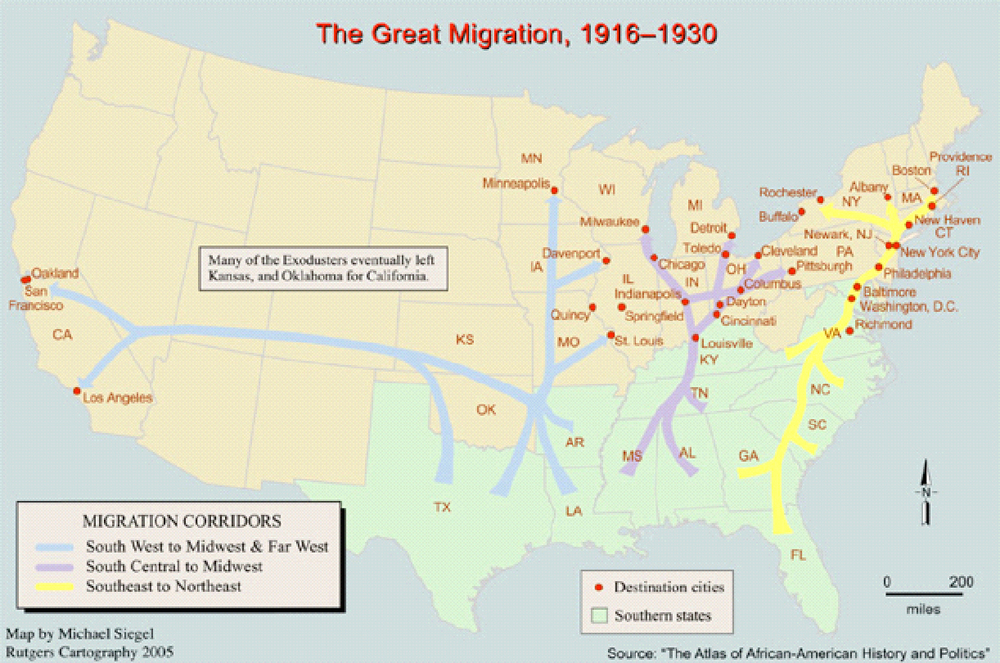
Related image

A map of the patterns of migration!

Marcus Garvey

Marcus Garvey’s selections of texts made for an interesting read. He highlights not just his own beliefs, but the push back he experiences from others for it as well. And yet despite the fact that Garvey’s arguments in the texts provided do talk a decent amount about his experiences and the social structure that exist wtihin America, he does not do the same when it comes to the subject of creation a Nation in Africa. Garvey’s pessimism about African American’s ability to gain any political leverage within America can not be entirely dismissed, yet there still remains the question of why he never bring up these same possibilities when it comes to his planned nation state in Africa.

Marcus Garvey

In my opinion, I really like and I definitely have some respect for Marcus Garvey. As a kid and finally, when he became a man, he was learning about his African American race. Marcus started to figure out how black people were being treated over the world. He found out black people were being treated unfairly over the world and he did not find like that at all. I had mad respect for Marcus Garvey because he really wanted black people to be treated fairly and to be admired and appreciated. For him to get black people treated equally and respected more, he created the Universal Negro Improvement Association, so they can create their own country of black people and their own country of black people with their own black government. Marcus Garvey was a well-respected leader for that organization. He strived for African Americans to be equal and he is a person I definitely have respect for because of his bravery to fight for black people being treated fairly over the world.

Sernett Response

One of the parts of the African Methodist Episcopal Council of Bishops’ Address on the Great Migration (Chapter 38) that I found really interesting was the section called “Evils to be Avoided.” This section talked about how newcomers to an area will be exploited by the people who already live there. The Bishops say that the newcomers will get lost in “leisure and idleness” and this will lead them to being taken advantage of. They warn against going to a new city because they say that it will end in a new “form of bondage.” I think this is a really interesting argument because the “new city” that the Bishops are talking about is the North, where many of the African Americans are moving during the Great Migration. However, I don’t know that this argument holds much weight because it seems to me that the North would be safer for and more welcoming of African Americans. Not to say that everyone up North is going to be welcoming; that’s of course not true. But in terms of degree, the North is likely to be a better, safer place for African Americans to live during that time period than the South. I think that a more valid argument would be to point out the importance of maintaining and growing an African American religious community in the South, where such a community could do a lot of good for the African Americans living there.

African Methodist Episcopal Council and the World War

One of the most interesting parts of the readings this week was the African Methodist Episcopal Council of Bishops “Address of the Great Migration (Sernett, Chapter 38).” The reading was a letter from all of the heads of the AME church to other pastors who were not in attendance of a congress about the state of the AME church and where it was going. While the great migration was the focus of the readings this week this reading takes a moment to look at the big event in the world that was also playing into the state of their congregations, World War I or the “Great War”. They believed this war was going to cause people to question their faiths and ask “Is there a God?” due to the atrocities that were occurring in Europe. The AME church takes a stance by saying that they should all continue to live holy lives and continue their faith during this time of strife. In the reading it says ” We appeal especially to those whose intellectual, moral, and spiritual guidance we are so largely responsible…..(to) the faith that was once delivered to the saints (Sernett 361).”  When the US got involved in the war, to encourage more African American men to enlist in the war effort, the government often used religious imagery or statements in propaganda to show that it was their holy duty to go to war. You can see a great representation of that here:

Photo found from: http://reasonsociety.blogspot.com/2010/02/us-religious-propaganda-posters-from.html

With the AME Church taking a stance to continue to foster this belief in God and fighting against going to war it goes against this idea that the government is putting out in their propaganda.


The Great Migration


In high school, when we learned about the Great Migration, we focused mainly on the economic aspects, and then the social ones in terms of standards of living. Never did we talk about religion, and the impact that the Great Migration had on both the religious institutions of the north and of the south. Harvey even argues that “one of the most significant forces shaping the black experience was the Great Migration…[it] shifted the center of African American religious life” (Harvey, 87).

One of the things I love about the two books we read is that Harvey explains these movements, these huge religious events and ideas in broader terms, and in Sernett’s collection, we’re able to put personal experiences, faces, and testimonies into the bigger picture. Harvey mentions Holiness/Pentecostal movements, Mt. Olivet Baptist Church, the beginnings of mass community work, the Church of God in Christ, and Marcus Garvey. We then read these ideas from the actual people themselves, and they no longer become just ideas, they become a lived experience and reality.

Mt. Olivet Baptist Church in Chicago, Illinois, became the largest Protestant church in the United States, with a membership close to twelve thousand by the 1930s. It’s very clear that without the Great Migration, this would not have been possible. It likely would have remained the First African Baptist Church in Richmond, Virginia. This really shows what Harvey discussed, about the shift in the center of African American religious life. What’s more, though, about Olivet is the massive nature of their community outreach and service programs. It seemed to me that Olivet was a precursor to the modern megachurch, not only with size but with these programs.

Mattie Fisher and Mrs. Jessie Mapp are very religious in their language and focus heavily on the idea of service. They are part of hundreds of missionary meetings, services, prayer meetings, the Baptist Young People’s Union, and Sunday school. They see religion as a way to serve the growing, urbanizing community around them, and use that to attract members. The last line of Mapp’s excerpt struck me: “We need a trained ministry to teach our people. They need more teaching than preaching. They need to be taught the Word of God” (Sernett, 370). Despite their newfound service commitments, these women are still Baptist (and Protestant) in nature — the Bible is the Word of God, and it’s all a true believer needs. When it comes down to it, the Bible will not fail and is the best method to attract and keep followers.

Mt. Olivet Baptist Church, Chicago, Illinois, circa 1938

(clicking on this will take you to the Vimeo site to watch the video)
W.E.B DuBois and Booker T. Washington

I thought it was interesting that this week we had readings from WEB DuBois and Booker T. Washington. Traditionally you would never think of them as “religious” thinkers but Sernett bringing them in shows a stark contrast. Most  of the readings that we have read previously to this are more from religious figures and people who strongly believe in their God. DuBois in his writing goes into the idea that God was siding with the white people and abandoning blacks and that people shouldn’t be worshipping someone who does not support them. Washington takes a different approach where he is looking from a place of struggle and hoping that everyone could move towards peace. Both pieces were extremely interesting and brought a change from the ideas of past readings.