Monthly Archives: October 2017

From the Queen of Sheba to MLK: Black Beauty

From Davis’s work, the beginning paragraphs about King Solomon and his queen were very empowering to read. As a young, black woman in this generation, embracing my culture and roots is what drives me to succeed. It’s like we live in a caste system according to race, in my opinion, and breaking the barriers is what I aspire to do more than anything. Accordingly, reading a work that begins with emphasizing the glory and beauty of a black queen was reassuring. We, black people, are not exposed to the historical Black queens. We don’t see the excellence we derived from on a normal basis.

The quote, “a beautiful woman with black skin,” speaks to my soul. Literally, it will probably be my next Instagram caption. From my experience throughout life, when it comes to beauty, black women are overshadowed. We are lesser just because of our skin and other dominant physical features, such as wider noses, coiled hair, fuller lips, curvier figures, etc. To know that throughout history, black beauty has been expressed makes me overjoyed. Additionally, the quote, “I am black and beautiful,” made me think of a speech by Martin Luther King Jr, that was about black people signing their own Emancipation Proclamation. (attached video) In the speech, he speaks about how black is synonymous with being ugly or lesser while white is associated with more positive, attractive thoughts. He states, with strong passion, “Yes! I’m black, and I’m proud of it; I’m black, and I’m beautiful.” I wonder if he was exposed to the story of the queen of Sheba. Lastly, the quote, “since the queen of Sheba is black, so must the church be black and beautiful,” is my favorite of all. It’s my favorite because it encourages and reinforces black beauty. I think of it in a role model context and how it positively affected the youth. I feel that youth, especially now, need to be reminded that they are beautiful.


The following quotes are from MLK’s speech:

“I come here tonight to plead with you: Believe in yourself, and believe that you’re somebody!

“I said to a group last night, nobody else can do this for us. No document can do this for us. Not even an Emancipation Proclamation can do this for us. Nor can a Johnsonian Civil Rights Bill do this for us.

“If the negro is to be free, he must move down into the inner resources of his own soul and sign with a pen and ink of self-assertive manhood his own Emancipation Proclamation.

“Don’t let anybody take your manhood. Be proud of our heritage. As somebody said earlier tonight, we don’t have anything to be ashamed of.

“Somebody told a lie one day. They couched it in language. They made everything black ugly and evil. Look in your dictionary and see the synonyms of the word ‘black.’ It’s always something degrading and low and sinister. Look at the word ‘white,’ it’s always something pure and high and clean. But I want to get the language right tonight. I want to get the language so right that everybody here will cry out, ‘Yes, I’m black, I’m proud of it! I’m black and beautiful!’”

A Different Attitude

This week, the reading that caught my attention was the account of Henry McNeal Turner. This account stood out from the rest in that it had a different tone than most others that we’ve read thus far. While the other accounts have been characterized by tones of devotion, frustration, unfeelingness, etc., this particular account had far more of a sarcastic, even indignant sort of tone to it.


This account was written in response to statements given by Bishop Benjamin Tanner (Sernett 289). As such, the account was written in a defensive, argumentative perspective. Its purpose is to refute the statements given, which is accomplished efficiently and eloquently throughout the account as Turner provides evidence against Dr. Tanner’s statements. Turner provides some intriguing and thought-provoking arguments, such as the idea that “People must have one like them on high to inspire them to go high.” (Sernett 290). This is just one of the many interesting statements within the chapter, but this is definitely one that encourages further thought.


The most memorable part of the chapter, though, was the line, “If I were so ignorant, I would hold my tongue and pen and not let the people know it.” (Sernett 294). This line in particular set this chapter apart from the other chapters we’ve read, simply for the attitude behind it. It was quite unexpected given the fairly formal tone of many of the other accounts and made this chapter incredibly memorable.


In short, Henry McNeal Turner’s chapter is entirely engrossing as it captivates readers with the author’s attitude and earnestness throughout.

Readings- Week of 10/2

I actually really found the first reading interesting, and not just because I didn’t read any of the others. It was refreshing to see something that so blatantly called out white people and their wrongdoings that was written in this time. I also just really liked how he slyly called for slave insurrection. It’s a mystery to everyone, including myself, as to whether I would have called for slave insurrection, but I just like the ability he has to make you see the subtext without spelling it out to you.

One reading that struck a chord with me, however, is Black Religion in the Post-Reconstruction South. I’m not going to lie, it has occurred to me that some of the ecstatic worship going on in the black might be fake, but it never occurred to me that someone could be seen as uneducated because of the way they worship. While I know that some people are just shouting to shout in my church, I think that some of them generally worship that way, and that’s why I was kind of rubbed the wrong way with his thoughts about ecstatic worship in this passage. I think his thoughts on that type of worship also show a clear division between black worship in the south and north. It makes me wonder why that difference existed, and if it still exists today.

10/4- aaa(frica) STOOOP! i coulda dropped my rights as a citizen in the country in which i was born

In this week’s readings, none stood out to me so much as the words of Henry McNeal Turner, and his argument for emigrating to Africa. His perspective was one I had not really considered in the great argument from previous chapters for/against African emigration. A great deal of his argument was rooted in pessimism for the future of America. Honestly, he was right. Turner argues that “until we have black men in the seat of power, respected, honored, beloved, feared,hated and reverenced, our young men will never rise…” (Sernett 290). One might argue that, with the election of Barack Obama in 2008, Turner’s prophesy was disproven. Though it would be lovely to believe it so, it seems this aspect of his ideas of America’s future still remains to be seen. Sure, Obama was elected president. But in his administration he was belittled and overruled and reviled by white members of our own government, to the point where party lines seemed to be a convenient excuse for putting America’s first black president back in his place.In this week’s readings, none stood out to me so much as the words of Henry McNeal Turner, and his argument for emigrating to Africa. His perspective was one I had not really considered in the great argument from previous chapters for/against African emigration. A great deal of his argument was rooted in pessimism for the future of America. Honestly, he was right. Turner argues that “until we have black men in the seat of power, respected, honored, beloved, feared,hated and reverenced, our young men will never rise…” (Sernett 290). One might argue that, with the election of Barack Obama in 2008, Turner’s prophesy was disproven. Though it would be lovely to believe it so, it seems this aspect of his ideas of America’s future still remains to be seen. Sure, Obama was elected president. But in his administration he was belittled and overruled and reviled by white members of our own government, to the point where party lines seemed to be a convenient excuse for putting America’s first black president back in his place.

Turner’s argument also seems more reasonable and multifaceted than my initial impression of the ACS led me to believe. I thought that the ideals of the ACS were rooted in the idea that black Americans were not truly Americans (an idea I assumed was propagated by white Americans), and that the plan was to emigrate every black person “back” to Africa (regardless of their not really having been raised there). Turner’s points prove this impression otherwise, at least from his account of ACS’s ideals. In fact, Turner is comfortable in his status as an American, and wishes that his America recognized him as a true citizen, rather than second-class. He refutes the idea that #NotAllWhiteAmericans are bad, since even the pervasive idea that the North was “the good side” was a false narrative when considering how complicit the North was in the subjugation of black Americans. Turner also does not wish for all the black Americans to emigrate to Africa at once. It’s his idea that even a small amount of black Americans could start a viable civilization in Africa. The fact that he uses the example of emptying the penitentiaries to build a civilization really struck home for me, especially considering how pervasive the school-to-prison pipeline is to this day, and the fact that black Americans continue to be jailed at disproportionate rates compared to the relatively insignificant (and, in some cases, nonexistent) crimes they commit.

And now, in an occasion that I am unreasonably excited about, I will post a photo of Henry McNeal Turner.

That’s right. Not a painting or sketch. A PHOTOGRAPH.

“I did it to stop their mouths”

In the primary reading by Brown, one of the people he interviewed told him that nobody would believe her in her church that she was truly a Christian until she “had one shouting spell.” Furthermore, she finally faked it to get them off her backs. This was part of a bigger narrative of what I believe was entirely performative religion to get money and status, but it reminded me that this weird branch of performative-ness is still alive and kicking in the church. Specifically, people really like speaking in tongues (and various other “gifts of the Spirit”) to prove that they’re holy. I had a youth minister at one point who told me she had the gift of prophecy, and that she knew every little thing in my life because Jesus told her so. Not gonna lie, I was never happier than the day I moved away from that church.
But like, a lot of people fake speaking in tongues, and it’s…. really obvious. I can’t remember what sect it is of Christianity that likes all their members to have a really obvious (by which I mean weird) fruit of the spirit, but those people very much enjoy speaking in tongues, and it’s…. pretty fake.

https://www.youtube.com/watch?v=YMFBxQFm-X0

This is the kind of thing I mean. I’ve seen it on mission trips and at church, and every time I’m amazed by how forced it seems and how little it seems to do for anyone. On the flip side, though, it means you’re definitely holy, so people will stop getting on you for why you’re not going to heaven.

Is Brown Talking Down?

William Wells Brown’s piece certainly stood out to me among the other texts that we have read so far this semester. This was one of the few documents that was not focused on racial power dynamics and the role that religion played in that. Instead it was more focused on African American churches themselves and how they function. It was interesting how Wells when quoting other African American in the work, wrote them in dialect. I recalled the discussion we had earlier in the semester, discussing how this was a tool used to dismiss the voices of African Americans. While it is possible that Wells is simply quoting them in this way out of a desire for accuracy or simply tradition, the context that it is in seems to give credence to the notion that this is also an attempt to dismiss and trivialize them. While the overall idea of the article is something that I certainly understand and can even agree with, the way that he goes about it seems to have a slight air of elitism and condescension to it, separating himself, “a man of letters” from “less educated” individuals.

Sernett Response

One element of the readings this week that particularly interested me was in Chapter 27 of the Sernett reading. William Wells Brown mentions that one young woman he talked to had told him that it wasn’t until she’d had a “shouting spell”  in church that her Sisters believed she had “the Witness”. When he questioned her, she admitted that she had shouted not because she’d had some great religious realization, but because she wanted the Sisters to stop bothering her about it. This sort of strange peer pressure situation makes me wonder about the legitimacy of the Sisters. Did they actually feel something, a connection to God or some higher power when they shouted in church? Or did they all end up somehow being drawn into this situation because they wanted to fit in with the others in the church, or because they wanted to believe that behaving this way would bring them into closer contact with a higher being? Of course, there’s no way to know. It’s completely plausible that this shouting truly did cause them to experience a “Witness”, and that the girl Brown talked to was an exception. This phenomenon is just so interesting to me because it can be applied to many different aspects of our lives. It reminds me of freshman year, when a hypnotist came to perform a few nights before school started. He asked for volunteers to come up on stage and proceeded to hypnotize them and make them do all sorts of crazy things. As someone sitting in the audience, I definitely thought it looked pretty real. However, my friend was one of the people the hypnotist had chosen and he said that he’d had complete control over himself and had gone along with the hypnotist for the sake of the show. However, I heard from other people that some others who had been onstage had said they actually were hypnotized. There’s no way to know for sure, really. Maybe it was different for everyone, or maybe the people who said that they were really hypnotized were just going along with it, even after the show was over. This kind of group mentality just fascinates me, whether is be people in a (possibly) legitimate hypnotist show, or a woman behaving in a certain way just to fit in with the Sisters at her church.

Davis Walker

David Walker was my favorite of the week. He actually said what I have been waiting for someone to say. He mentioned how the American preachers were preaching something and then totally went back on what they said. Walker discussed the irony of how Christians would send out missionaries to convert the slaves and then when the slaves pray their masters beat them. That personally never made any sense to me. The masters wanted their slaves to convert to Christianity, but also did not want them to pray. I guess they did not want to pray for freedom, but they could at least pray once the work was done.

Walker had written about how Americans can believe in the Bible, but then do or say something that goes against it. Towards the end of this chapter, Walker mentions how Americans need to repent. That was an idea that never crossed my mind. It makes sense for him to say that. Christians do repent if they have committed a sin or something against the Bible. I have never seen or heard that statement before.

First African American Catholic Congress

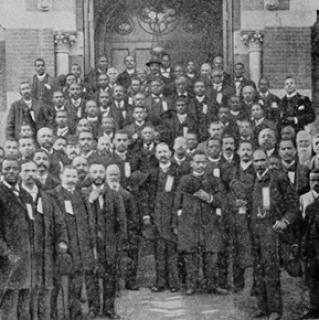
The first national gathering of people in America was the Black Catholic Congress, held in January, in 1889, at St. Augustine Church in Washington, D.C. The driving force behind these gatherings was Daniel Rudd. In 1886, Rudd founded the American Catholic Tribune, a newspaper for African-American Catholics. At the congress, Reverend Father Augustus Tolton, the first recognized African-American priest, celebrated Solemn Mass. The congresses were a coming of age moment for African-American Catholics.


Image result for first african american catholic congress


Investment

Out of the weekly readings, Sernett’s chapter 27 of African American Religious History gave me the most insight. William Wells Brown, although blunt, spoke about issues that some African American communities face currently. The part of his excerpt that resonated with me the most was towards the end of the chapter when he talks about the Petersburg Baptist church tearing down an old monument and rebuilding it for the sole purpose of glamour and recognition from sister churches. When discovering the news, he criticizes the priorities of the church which was quite taboo at the time. Even in today’s times, less fortunate people put their hard earned money into institutions that have no beneficial intentions for them. Instead of having flashy items that make the church “worldly-minded” in the words of Brown, he suggest that the church actually uses the people’s funds to build programs for their benefit rather than skewing the capital distribution. By doing this, it creates a less money oriented church, helping members and leaders focus on faith.


This interview from Dr. Umar Johnson speaks about the same investment turmoil that the African American community faces today.

http://https://youtu.be/SaUMQDjsAt0