Monthly Archives: November 2017

African-American Islamization

“I don’t think we should run around trying to love somebody who doesn’t love us.”

Malcolm X, February, 1965.

Like Christianity, many African-American Muslims find their religious histories rooted in Africa. In all of the readings, there are links to Africa. Though they varied, depending on the branch. For Nation of Islam, seeing the black man as the “original man” is instrumental to the faith. Also within this “black consciousness movement” are the ideas of “Yacub’s History” seen in both the Curtis essay and in the words of Malcolm X. In Malcolm X’s later speech, after his conversion to orthodox Islam from Nation of Islam, he said there were “four different types of people in the Western Hemisphere who all have Africa as common heritage.”

There are an estimated 660,000 – 825,000 African-American Muslims (~23%) in the United States. Predominantly, they practice Sunni Islam (orthodox). There are also those that follow teachings of the Nation of Islam, the Moorish Science Temple of America, the Five-Percent Nation, the United Nation of Islam, and Ahmadiyya. Muslims in the United States are diverse. African-American Muslims, specifically, have “constructed what is ultimately an imagined communal identity…this is dynamic, not stable; negotiated, not given” (Curtis, 661). We’ve also discussed the idea of identity, and using Africa as an identity-marker, but some Muslims decided to use their religion as their first identifier: “Islam solves the identity crisis.” The idea is that religion is so powerful it is the only thing needed, because it’s all that God asks of you.

Last year, I went to a local mosque for a paper. While I was there, I discussed orthodox Islam with the woman I met, Aishah Hassan. I remember her telling me that in the United States, a lot of mosques have been converted from Nation of Islam places of worship to that of orthodox Islam. She made a comment along the lines that they realized they were not the “true” Islam. This could have a connection to Malcolm X’s own conversion and transformation from Nation of Islam to orthodox Islam. I’m also left wondering the connection between orthodox Islam’s history in the United States, its high concentration in the Midwest, and the origins of Nation of Islam and Moorish Science Temple in Detroit and Chicago. But at the end of the day, who are we to decide which is right and which is wrong? If it answers questions people have, gives them something to believe in, are we right to claim they are wrong for believing in it? 

———————————————————————

Nation of Islam Comic Strip by Majied

Illustration by Majied
Separating Color from Religion

There were 2 readings that really stuck out to me this week, the speech by Malcolm X called “A Black Man’s History” and the essay by Edward E. Curtis IV called “African American Islamization Reconsidered: Black History Narratives and the Muslim Identity”. In most history classes you take when you are younger, Islam in America is always looked at like it is a solely African American religion and not a more widespread and widely practiced religion that it is. We look at Islam like the Nation of Islam is the same thing when they have different objectives. The speech “A Black Man’s History” was given when Malcolm X was in the Nation of Islam and had not yet converted to Islam. He looks at the Nation of Islam of like it is one of freedom for only the blacks. He says “The white man doesn’t (separate race and religion). The white man never has separated Christianity from white, nor has he separated the white man from Christianity. When you hear the white man bragging, ‘I’m a Christian,’ he’s bragging about being a white man (Malcolm X),” He argues the point that African Americans never had their own religion like that and makes the point that the Nation of Islam should be that religion for them. Curtis is making the point that over time many nations have been “Islamicized” and that the Nation of Islam was an Islamicized religion. It did not follow the traditional Muslim values but still was kept under the same name and the “Religious values were of secondary importance (Curtis, 661).” Malcolm X later in his life converts to Islam and changed his practices and values but normally in history books the Malcolm X who practiced under the Nation of Islam is displayed,

Santeria

First off I have never heard of Santeria as a religion. I have only heard of the song. Here’s the song: https://www.youtube.com/watch?v=QMJ5mgEzSwM

Although, its members were Afro-Cuban so it would make sense about why I have not heard of it. Second, Santeria has many different names. I am not sure why there is a lot of different names, but there are.  Anyway, I think Santeria is my favorite religion to be discussed so far. It is interesting that the women were leaders and in charge. Several women thought of God as feminine and being the Mother instead of the Father. There is a separate book of rules to follow along with other names to call God and the Devil, this reminds me of the 7 pillars.

I have read some parts of the Holy Bible and those parts that I have read confused me. But this backstory of Santeria had me thrown for a loop. Talking about sisters, Orisha, Ogun, and a whole bunch of other “O” names, it was hard to remember who did what. After finishing the chapter, I can compare Santeria to more of a mythology standpoint. It kind of reminded me of when I read the Percy Jackson series.

Towards the end, we get to where the blood sacrifices are taken place. So the women are in charge of the life giving ceremonies and men give death. I am guessing that the men sacrifice their own blood or blood from an animal. I do not know why I thought that they did not do blood sacrifices, I only thought that the Aztecs did that.


Santeria

It was interesting for me to start the Santeria reading, because me and my friends had literally just had a conversation about why society is more accepting of women wearing what are deemed ‘masculine’ clothes, than of men wearing what are considered ‘feminine’ clothes. We basically gave up and came to the conclusion that everything is a social construct, but the beginning of this chapter answered so many of the questions me and my friends talked about. As well as opening my eyes to so much more. It never actually occurred to me the amount of structural, hidden inequality that exists in society. The fact that pretty much all mainstream religions are male dominated actually went completely over my head, which is actually ridiculous. I’ve read about Santeria before, but the new way this chapter approached it really kept my interest, and actually makes me really interested in the roles women play in religion now.

A Gendered Perspective

A few lines that stood out in particular this week were found in the Santeria reading, pages 2-3. “Much philosophical thinking assumes what is known as the ‘normative male perspective’… This deep-seated preference for characteristics that have been culturally constructed as male over those that have been constructed as female as well as over other cultural gender constructions has led to a general acceptance of women who want to act like men but a continued abhorrence of men who take on any characteristic that has been culturally defined as ‘female’.”


It was curious to think about how slanted the idea is that female adoption of ‘male’ characteristics versus male adoption of ‘female’ characteristics is. The very idea of ‘male’ or ‘female’ characteristics is an interesting one, as we as a society have dedicated gender to personality traits or general attributes, and then cast judgement on who is allowed to portray such things. Rarely do I truly consider the level of import that society has placed upon such ideas, to the extent that it has long since reached into our literature and other such sources that we read on a daily basis for English classes and such, but when I come across a line like this one it becomes apparent.

That Voodoo that You Do

One of the most interesting things about Voodoo that I learned from the readings, is that unlike Christianity, Voodoo does not follow the mentality of good versus evil. Instead it goes by the idea that there are actions that are constructive and actions that are destructive. This seems to be a far more pragmatic and nuanced worldview to me. It seems like a system that is less interested in steeping morality with simply traditions and religious practices, but instead simply wishes people to do what is best for their own community. This would also make it much more difficult to use this religion as a political tool. Instead of creating division of good groups and bad, to use to shape relationship that they might have with outside communities in order to force some type of authority or morality over them, it is instead more interested in much more immediate relations and decisions connected to their own well-being.

Santeria

I found this chapter very interesting because I learned a lot about Voodoo. This chapter made me check my ignorance on the topic. Due to my personal religious background, I was taught that Voodoo and Satanism were synonymous but after reading this chapter, I learned that that is not the case. Also while reading this, I continually thought about the Disney movie The Princess and the Frog. More specifically the voodoo man who had a somewhat major roll in this movie. As I was reading, I tried to compare the movie. I attached a video of the Voodoo man’s song from the movie!

Friends on the Other SIde


Santeria, Voodoo, Obeah, And Similar Religions

The reading for this week actually correlates very closely with a topic in my Personality Psychology class. This is the of humanistic psychology, and its origins which lay in the original foundations of existentialism. This addresses the main questions of why are we here and what is the purpose our existence? The reason why I connect this to this weeks reading on various religions that began in Africa, is because I hold to the belief that many people find their purpose, and identify through religion. However, as psychology argues how we perceive our own reality is the result of our constructs. As was noted in the reading, Santeria and Voodoo are very closely related to each other. Nonetheless,  regardless if these charms and practices are used for good or evil, I think is the result of how one perceives their own reality. One of the biggest issues that I think can arise from studying followings in Voodoo and similar practices today, is we now have more science on our side. As the article connects, behavior of individuals who were claimed to be chosen by certain African Gods, we said to present with the same behaviors as someone with whom today we would claim to have multiple personality disorder. Furthermore, although I am aware that I do not hold the common opinion on this matter, I think it is important to note that priestesses, and those who were chosen to be the “vessels” of other worship gods, often came from a family of it. For me personally, this raises questions in my mind about how much people brought into these practices, or if it may have been a societal pressure.  In addition, I still wonder why the concept of voodoo itself, to many people in New Orleans, is still thought of as a dark practice. Seeing as my mother grew up in this city, as a child my grandmother have certain superstitions and rules we had to follow in order to get what she would refer to as bad juju. Of course, this comes from a woman that lives a haunted house, and gets mad every time we bring up the top of Ojai boards, which she’s never allowed in her house, even when my mother was young..

Santoria

I thought that the readings this week were really interesting. The only experience I’ve had at all with Santoria is when they mention it in the movie The Hot Chick. I was also really interested to read about voodoo because the only place I’ve seen that is in the beginning of the movie Lilo and Stitch. I was a little bit unsure when the chapter about Santoria was talking about all the numbers. The chapter said, “Shango recognizes the numbers 4 and 6. Numerologists add 4 and 6 to make 10, and then add 1 and 0 to make 1.” I was very confused by this. How does Shango only recognize the numbers 4 and 6? Do other numbers not exist, or are these numbers special for some reason? Why do numerologists add them together to make ten? What is the point of that? Also, couldn’t anyone add 4 and 6 together to make 10? Why mention numerologists? Why do the numerologists add 1 and 0 to make 1? What does that mean? Why those particular numbers? I was just very confused by that section. I thought that it was very interesting to read about the other rituals and ideas of the religion, however.

Santeria and Vodun

Called “mysterious Afro-Christian syncretized religions,” in the Fanthorpe reading, Santeria and Voodoo (Vodun) are much different than what people expect. Perhaps people’s misconceptions and misunderstandings lie in the lack of real written histories and material. The traditions are still largely oral, passed from generation to generation. Some people see these traditions, Santeria and Vodun, as witchcraft or satanic, but that assumption is largely false. The two are also seen as synonymous, which would also be wrong to assume. Just because they are both African Diasporic Traditions does not mean their belief systems and structures are even close. I located the Santeria Church website, and they identify the differences between the two faiths, for a further explanation to what the chapters given explained.

While Christianity has the idea of “good versus evil dualism,” Santeria does not. Instead, the “universe is subject to opposing forces such as expansion and contraction (which are not of themselves good or evil)…everything in the universe has positive attributes (Ire) and negative attributes (Ibi).” When I read this, I thought it made more sense than what I’ve largely been taught or read through Christianity. It’s easy enough to say in Christianity that God is good and the Devil is bad, and you either are saved or a sinner. There is no room for gray areas. Though as we’ve seen, it’s much harder to put this into action. But with this Santerian idea, that the universe, and subsequently humanity, are on this spectrum of positive or negative, giving or taking, it allows for the inevitability of some people to be human. It’s about creating “right character,” and living a right life. This is a very Christianized idea, the idea of living a Christ-like life, but Santeria seems to give it a more community-oriented, human-oriented spin, likely connecting to the African roots of it.

Both of the chapters also discussed the idea of religion and studying religion in general. The Fanthorpe chapter described religion as “an attempt to understand and explain the universe and the vast forces within it, to control or influence those forces, and to influence human thought and behavior.” I found this an incredible definition, because it includes everything, and it doesn’t necessarily assign divinity. I also thought the idea presented in the chapter from “Where Men are Wives and Mothers Rule,” that religion has a “presumption of maleness until otherwise said,” is something people don’t tend to think about. Abrahamic religions assign male attributes to God, and all important, frequently-discussed figures are males. The role models offered are all essentially male. Santeria’s practice of creating this instead female-normative system is something that I’m sure caused its controversy, but also gained it some powerful, strong women to work and lead within the community.

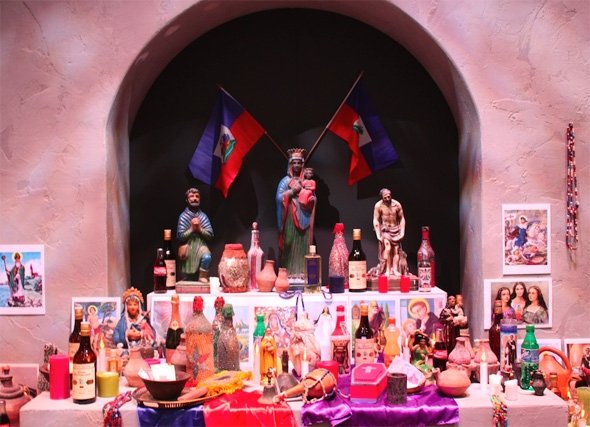
Haitian Altar