Monthly Archives: November 2017

The Power of a Voice

For this week’s reading, the chapter about Mahalia Jackson resonated with me the most. I enjoyed how passionate she was about the music of her faith. She embodied the music itself and fused it with the roots of her culture which was very interesting to me. In terms of African American music and religion culture, she influenced and paved the way for many musicians we see today, Aretha Franklin being an example. On a personal note, many churches that I grew up in used Mahalia Jackson’s music style as the basis for praise and worship sessions. We also see Jackson’s influence in movies such as Disney’s “The Princess and the Frog”. Another concept I enjoyed while reading this chapter was the versatility of brass bands. From block parties to funerals, these bands were the heart and soul of these functions.

Freedom Songs

In the Mahalia Jackson chapter, music was relevant. She discussed how during protests they sang spiritual hymns. The freedom songs allowed the civil rights activists to spread their word out in a more memorable way. Freedom songs really did inspire people. When people began to sing spiritual music during boycotts and sit-ins, it shows how deeply rooted freedom songs are. On page 546 of Sernett’s book, Jackson states that King wanted her to sing “I Been ‘Buked and I Been Scorned.” When she sings the song she gets full with joy and happy about how much progress had been made. There is something about slave songs, that are typically religious that goes along with movements. Both deal with struggles and what people need to overcome.

Here is a video of Martin Luther King Jr. and Mahalia Jackson: https://www.youtube.com/watch?v=odHqG1rA4M8


Chappell giving me McClurkin vibes

While reading Chappell’s works, Johnnie Carr reminds me of what my mother’s idea of a “model Christian” would be. Carr’s constant faith and thankfulness for the Lord is what I feel should be emphasized in every Christian church, no matter the detonation. The entire idea of Christianity roots back to the grade of God more than anything else. Carr wanted her actions to be portrayed as God’s doing not her. Meaning that her faithfulness is what better her situations. As I was reading, my brain was playing various songs by the Gospel artist Donnie McClurkin. When I was younger, my mother only played gospel music. It’s the underlying factor my religious foundation, and I did not realize that until this reading. My only connections to Christianity are through music. Inspired by Chappell, I have one of my favorite gospel songs on repeat.

MLK and Black Power

I really enjoyed reading Sernett’s reading on Martin Luther King and the civil rights movement. Martin Luther King Jr. went to and got locked up in Birmingham Jail for leading the civil rights movement. Even though he got locked up in Birmingham Jail, I liked how he encouraged the black community to keep fighting for they believe in having the same amount of power as white people do. Martin Luther King Jr doesn’t lead a raid to make African Americans get their balance of power that they deserve. Instead, he does it in a more nonviolent way. He leads a march of black people fighting for what they believe in. In my opinion, Martin Luther King Jr, trying to fight for power lead to the creation of black power. Black people were sick and tired of the problem of having little power.


Image result for martin luther king jrImage result for black power

Civil Disobedience

The first time I read “A Letter from Birmingham Jail- April 16, 1963” it was for my AP English Language class in 11th grade. We had just finished reading Civil Disobedience by Henry David Thoreau and were looking at people inspired by his ideology. The letter focuses on the ethics behind the jailing of the civil rights protesters and encouraging people to continue to fight. King uses a lot of religious comparisons to encourage his followers to continues their actions. He compares himself to the Apostle Paul leaving his home to carry the work of Jesus Christ across Europe (Sernett, 521). When I first read this piece in high school we missed over most of the religious prose throughout the letter so going back and re-reading looking for religious ideas was really interesting to me. I feel as King adding the religious pathos to the letter made it more powerful to the intended audience of this letter but also still appeal to others as well. Even if you were not religious, King makes a compelling argument but it is stronger with the religious tones which shows how King displayed himself too.

Martin Luther King Jr. in his Birmingham Jail cell. http://cdn.cnn.com/cnnnext/dam/assets/130415151936-king-jail-story-top.jpg


Religion’s Role in the Civil Rights Movement

In high school social studies classes, when we were taught the Civil Rights Movement, it was all about social concerns and politics. They were given as reasons, means, and ends. But as Chappell pointed out, the role religion played cannot be ignored. “The words of many participants suggest that it was, for them, primarily a religious event, whose social and political aspects were, in their minds, secondary or incidental” (Chappell, 87).

Chappell also goes into some detail about several important religious (and even non-religious) leaders. Sernett does the same, including four religious leaders besides the Rev. Dr. Martin Luther King, Jr. I think that when students are taught about the Civil Rights Movement, the dialogue is entirely of the Rev. Dr. King, Malcolm X, and boycotts, marches, and sit-ins. I think that Chappell’s goal in his chapter was to show that there were important things behind the scenes. Religion, spirituality, and how people connected to their religious and movement leaders. The Sernett readings were attempting to do the same, to show that there were so many elements that came together to become stronger, from religious conventions to powerful music.

The idea that the Civil Rights Movement was also a revival has an important implication — that it changed not only the United States politically through court cases and laws, but also spiritually. The goal became not “to bring politics into our morality but to bring morality into our politics” (Chappell, 90). The word choices of righteousness, truth, and miracle echo the ideas of changing not only how the country was doing things on the surface but  how the actual people were beginning to see things underneath — seeing past skin color. Billy Graham even started a dialogue on the color of Christ, an argument of seeing Jesus Christ in a new way, one that made it so Christianity truly could become a religion for anyone who wanted it and saw in it, hope.  
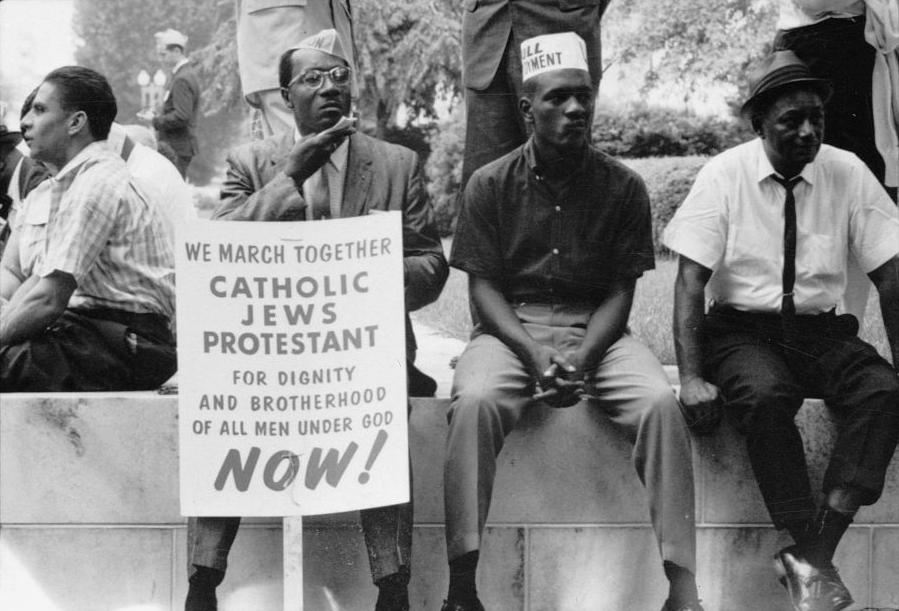
The Civil Rights March from Selma to Montgomery, Alabama, in 1965, from the Library of Congress


Ethiopian Hebrews

I really enjoyed reading about Ethiopian Hebrews in chapter 1, “Geographies of Race and Religion,” of Judith Weisenfeld’s book New World A-Coming. Since we have focused primarily on African American Christians, it was refreshing to hear about another religious community’s struggles, especially during such a tumultuous point in American history. The ideas toward Jewish racial identity set forth by Arnold Josiah Ford were striking. Since the 1920s-30s were decades which produced an increase of anti-Semitic beliefs on a global scale, the distinction Ford makes between Hebrews and Jews using racial identities displays a religious conformity to societal standards and practices of the early twentieth century. Later on in this chapter, Ford’s co-founder of BBA, Mordecai Herman “stressed Judaism’ s advantage in that it taught how to live rather than preparing people to die, which he saw as the substance of Christian teaching” (36). I hadn’t thought of this religious teaching comparison before between Christianity and Judaism. Herman’s succinct description here has truly left a lasting impression with me.

Miles Mark Fischer

There was one line in particular that stood out in this week’s readings. On page 465, as Miles Mark Fischer describes holiness and pentecostal churches, he says, “ It would seem, therefore, that some holiness and pentecostal have protested against the ‘exclusively Negro’ and the ‘primarily white’ denominations and have organized, shall I say, ‘Christian churches’?” (Sernett 465). This line reminded me of the discussion we had in class regarding W. E. B. DuBois and Booker T. Washington, and the differences in their arguments. As I flipped back to the chapters for that week, the very first line of Reverdy C. Ransom’s chapter seemed to connect to this line: “There should be no race problem in the Christian State.” (Sernett 337). While Miles Mark Fischer’s chapter contained several strongly opinionated statements regarding the alternative religious sects, this idea of non-exclusivity and upholding this important idea is a familiar one. Throughout our recent readings, we have read many accounts of churches that are either quite exclusive or significantly leaning towards one particular group, so to have another chapter that describes groups that move past this tendency is an interesting change.


Another thing that stood out, though, was the seeming incredulity with which Miles Mark Fischer describes these religious sects. For example, he says, “ It will indeed be of value to know those religious organizations which undertake to win the allegiance of Negroes by other than recognized Christian propaganda.” (Sernett 466). This line stood out not only because of the flippant use of the word ‘propaganda’, but also because of the unfeeling tone behind the statement. This same tone is used with surprising frequency throughout the chapter, with words such as ‘cults’ thrown about.

Race and Religion

The underlying factor in all of history refers to both race and religion. Rabbi Matthew’s reading expands that idea even further. Until the 30s, Jews were considered their own race, but just like everything else here in the US, it split into White Jews and Black Jews. This split was caused by White Jews claiming that being a Jew was hard enough and they didn’t need the social and economic challenges that came along with being associated with Black people. I find that utterly disgusting. Matthew’s words on how the Bible indicates no race was phenomenal. At the time, people claimed to be so holy but still continued to discriminate towards any type of demographic that was a minority. It’s disgusting. Matthew just made me remember how disgraceful American history is to me. Like, don’t claim to be so for God and then hate on God’s people.

Things Got Really Weird…

I’ll be honest, having to read through Judith Weisenfeild just ended up making my skin crawl. It went from a platform that seemed to make some sense, to something that sounded like it should have been re-created into an R-rated Hollywood film. Out of all three different followings that came from Harlem, the one that seemed to make the most sense to me in the beginning was Nobel Drew Ali of the Moorish Science Temple. This was the one that made the most sense to me and followed the most logic. The other two that follow this just get “squishy”, but in some really creepy and hypercritical ways. I will say my first criticism with as much care as possible, but seeing as this course is African American Religions is the course, race does have to be thoroughly considered and defined throughout numerous situations. One of my biggest issues that I had when reading about Fuad was actually his race. When I was able to see the photograph that Weisfield used in her text, it is pretty clear to me that Fard was what we would consider by today’s standards to be very mixed. But the thing that bothered me a lot was an observation that the author had made herself about how gifted Fard actually thought himself to be. The platform of his demonization was that the white race was the Devil’s race, and that the pure race was African Americas. However, a comment is made that Fard believed himself to be favored by God. That despite his complexion that would have many thinking that he too was of the “inferior race”, God had his blessing, and this was why Fard was able to be the people’s chosen disciple despite his very light skin tone. I find that rationalization freakishly convenient.. Also, the fact that Weisenfeild had to go into such detail to explain the beginnings of Fard himself (we don’t even know for 100% what his birth-name may have actually been) a bit shady. And why did he feel the need to change what country he was born in so much?

Father Devine honestly just made me really uneasy. My reasoning for this comes from something that I am sure not many of you have heard about before. Nicknamed “The Ten Commandments Cult” this bore a lot of resemblance to me to the House of Joy and Faith. Like this following, the “Ten Commandments” was marketed for the poor society of African Americas in Uganda. Founded by Joseph Kibwetere, this religion stated that he had a vision that the world was going to end. Because culturally this was what many people feared in Africa, Kivwetere made his faith almost an out to this doom. If you wanted to be a member of this faith, you had to give up all your possessions and cut ties with family members. In exchange, Kibwetere promised safety, meals, and healing. This parallelism is also seen in Father Devine, although the end isn’t as tragic as Kibwetere’s. The thing that really got to my core was that these followers literally made me think of the word “cult”. I mean, they had psychologist investigating that proved the cramped living spaces and atmosphere in general was causing people to become depressed and present with psychotic behavior… Furthermore, just the concept of Devine almost brainwashing his followers into associating him as the reincarnation of God brought to earth was just deeply unsetting to me. This reading for me really highlights a lot of my own beliefs of how religion and… delusion can really go hand-in-hand sometimes.